Image Credit: Near Media
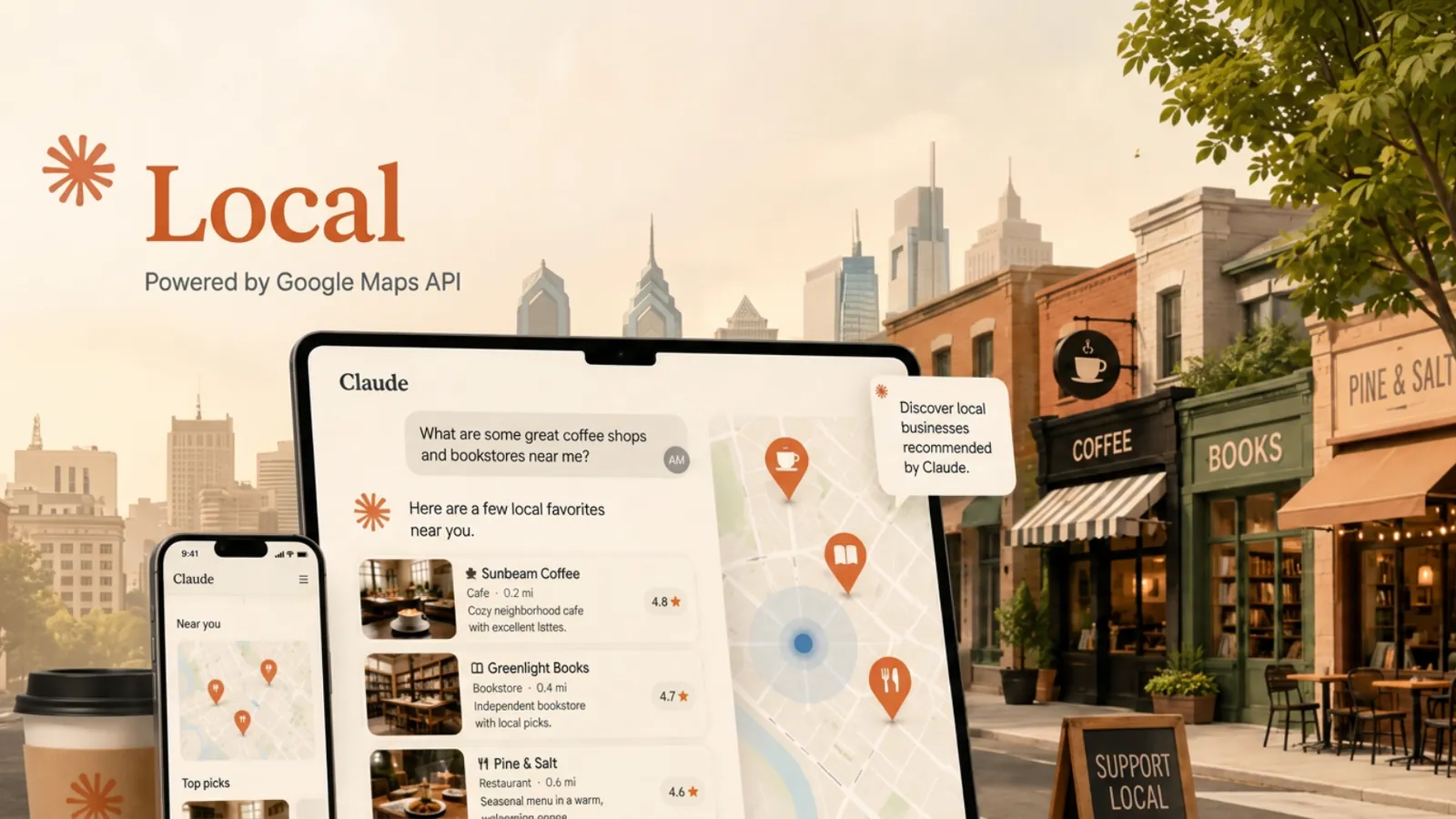
One of the more interesting AI stories this month was a small technical detail buried in Anthropic's product behaviour. When you ask Claude a local question, it now appears to lean on the Google Maps and Places API as its default source of truth. Researcher Nicolas Sitter's breakdown, picked up by Greg Sterling at Near Media, suggests that Claude's local results are being shaped by a familiar trio of factors: star rating, review volume, and how closely a business matches the query.
On the surface, that's a story about Claude. The more interesting read is what it tells us about where AI-driven local discovery is heading, and why retailers should care.
AI is converging on Google's local playbook
For more than a decade, anyone doing serious local SEO has been optimising against a fairly stable set of signals: accurate business information, category relevance, review quality and quantity, photos, proximity, and increasingly, the availability of live stock data.
What's genuinely new is that an entirely different category of product, a general-purpose AI assistant, is now producing local recommendations using essentially the same inputs.
That convergence isn't an accident. Claude is reaching for the most authoritative local dataset that exists, which today is Google's. Once you're using Google's data, you're implicitly inheriting a lot of Google's ranking logic too, because the signals available are the signals you can rank by. The rules of being findable in Claude look, at least for now, very like the rules of being findable in Google. If you've invested in your Google Business Profile, that work is doing double duty.
We don't yet have hard data on how much volume AI assistants are driving to local businesses, and it would be premature to claim this is a measurable channel. But what direction this is heading matters more than the current numbers. If AI assistants are starting from Google's local data layer, then the signals Google rewards are the signals AI will inherit.
That gives us a reasonably grounded way to predict what comes next.
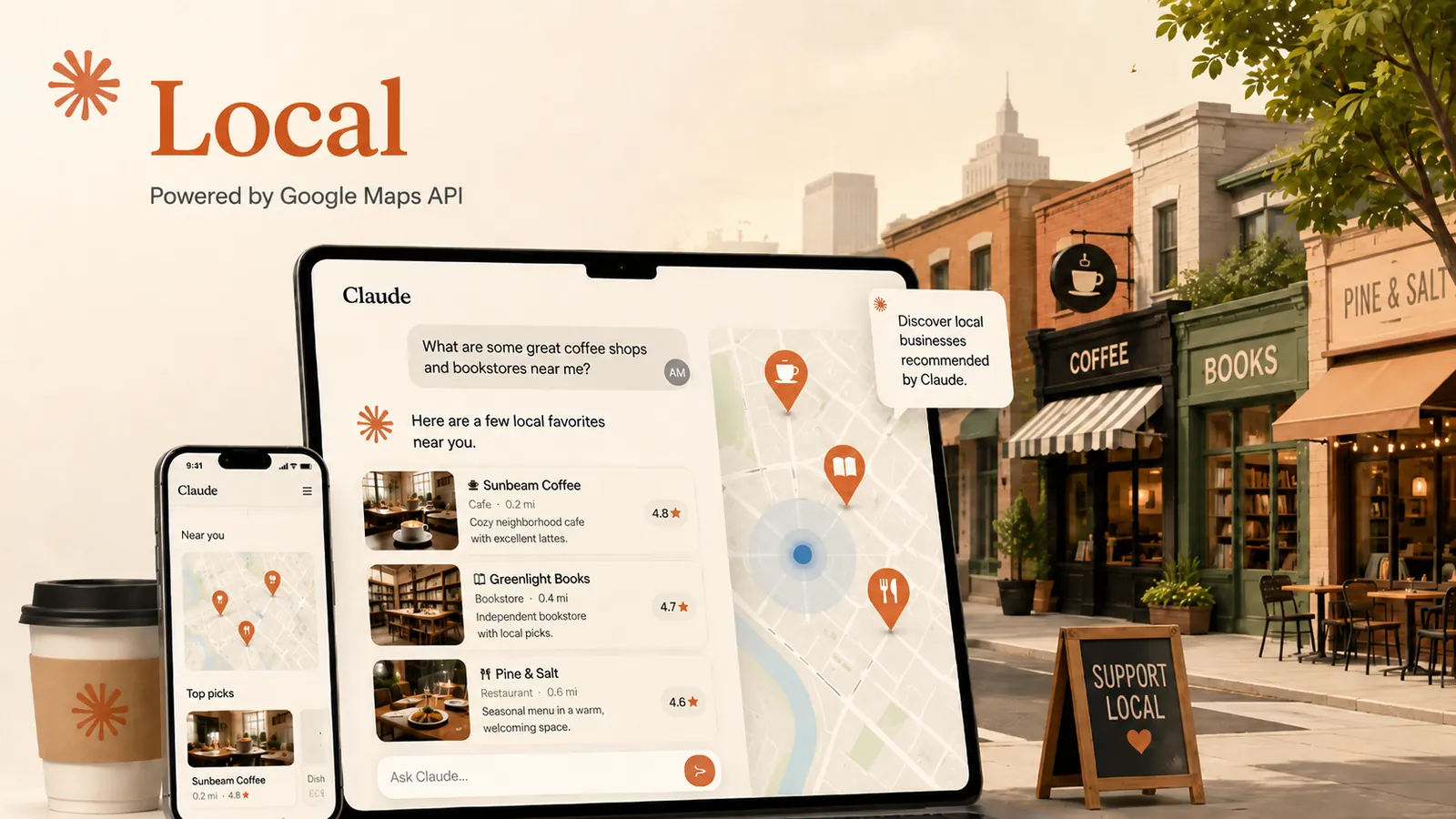 Image Credit: Near Media
Why we think live inventory is the next signal to matter
In our work with retailers, we see live local inventory data consistently improve how businesses surface on Google. Products in stock, accurately represented, with prices and availability that match reality lift discoverability both directly in shopping surfaces and indirectly in local results.
Claude's current behaviour is a small but telling data point. It's started with the simplest, most established local signals (rating, reviews, relevance), because those are the easiest to pull from Google's API. There's no reason to think it stops there. As AI assistants get more sophisticated about local intent, and as users start asking them product-level questions rather than business-level ones, the natural next step is for those assistants to pull in deeper, more specific data about what a business actually has.
In May OpenAI has also opened ChatGPT up to retailer product feeds. It's the same structured catalogue data retailers already use for Google Shopping, now powering automatic ads alongside the organic answers those feeds were already informing (reported in Search Engine Land). Same underlying move on a different platform: structured retailer data becoming the shared layer behind both AI answers and AI ads.
We're not seeing AI assistants surfacing local inventory at scale yet. However, what we are seeing across our own customers is that those with live stock data seem to be getting cited in local AI queries with greater frequency than those that do not. These results do not include live stock availability data in the responses themselves, however the fact these businesses are surfacing this data seems to be having a positive impact on how often they are being referenced in local queries.
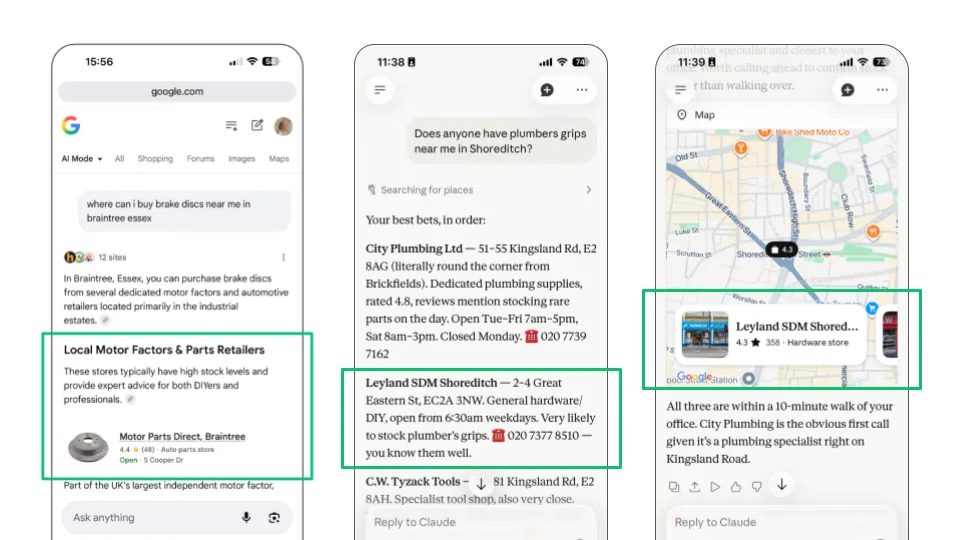
Retailers with structured, accurate, real-time product data already feeding into the channels AI is learning to read seem to be getting cited more often than those that don’t.
What this means for retailers right now
The practical takeaway is simple: the work to be discoverable in AI local search is, for now, mostly the work to be discoverable in Google local search, done thoroughly. That includes the Google Business Profile fundamentals everyone says they've done but very few actually have right:
- Accurate opening hours
- Categories that reflect what you really sell
- Attributes filled in
- An active and recent review profile
It also includes the piece retailers most often skip: making in-store inventory visible online in a structured, real-time way.
The reason that second part matters more than usual is timing. Being early to a new discovery surface is disproportionately valuable, because that's when you get the cleanest signal back about what's working. If you only show up in AI results in two years' time, you'll be optimising blind against an already-crowded surface. If you show up now, even at low volume, you start building the feedback loop that tells you what AI assistants actually reward, on your products and your locations.
This is the bet we'd encourage retailers to take seriously: assume AI local search is going to look more like Google local search than less, assume live inventory is going to matter there sooner than people expect, and get the plumbing in place while the surface is still small enough to learn from.
If you'd like a view of how your business and products currently appear across Google's local surfaces, and where the gaps are likely to bite first as AI assistants pull from the same data, we're happy to run a short visibility review with you.